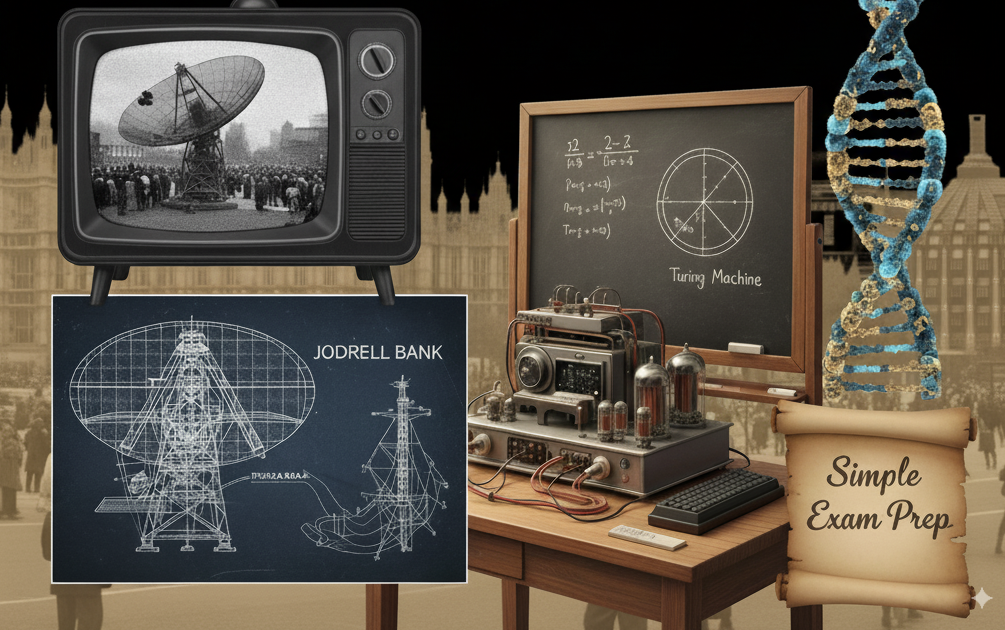
When preparing for the Life in the UK Test, you’ll need to know about the many scientific and technological contributions made by Britain. The 20th century saw an explosion of innovation, with British inventors and scientists creating breakthroughs that transformed medicine, transport, communication, and everyday life.
Our Life in the UK Test platform takes you through these inventions step by step, tests you with practice questions, and ensures you’re fully prepared for exam day.
Television
- Invented by John Logie Baird (1888–1946), a Scotsman.
- Developed in the 1920s.
- In 1932, he achieved the first television broadcast between London and Glasgow.
Radar
- Developed by Sir Robert Watson-Watt (1892–1973).
- First successful test in 1935.
- Used to detect enemy aircraft during the Second World War.
Radio Telescope
- Work with radar led Sir Bernard Lovell (1913–2012) into astronomy.
- Built the radio telescope at Jodrell Bank in Cheshire.
- For many years it was the largest in the world and is still operating today.
The Turing Machine
- Invented in the 1930s by Alan Turing (1912–1954).
- A theoretical mathematical device.
- Laid the foundation for computer science and the modern computer.
Insulin
- John MacLeod (1876–1935), a Scottish physician, was co-discoverer.
- Insulin became a treatment for diabetes.
DNA
- Structure of DNA discovered in 1953 at universities in London and Cambridge.
- Work by scientists including Francis Crick (1916–2004).
- Revolutionised medicine and forensic science.
Jet Engine
- Invented in the 1930s by Sir Frank Whittle (1907–1996).
- A Royal Air Force engineer officer.
- Transformed aviation and military aircraft.
Hovercraft
- Invented in the 1950s by Sir Christopher Cockerell (1910–1999).
- A vehicle that travels over land and water on a cushion of air.
Concorde
- Developed jointly by Britain and France.
- First flew in 1969; began passenger service in 1976.
- Retired from service in 2003.
Harrier Jump Jet
- Designed and developed in the UK.
- Capable of vertical take-off and landing.
ATM (Cashpoint)
- Invented by James Goodfellow (1937– ).
- The first ATM was installed by Barclays Bank in Enfield, north London, in 1967.
IVF Therapy
- Pioneered by Sir Robert Edwards (1925–2013) and Patrick Steptoe (1913–1988).
- World’s first ‘test-tube baby’ was born in Oldham, Lancashire, in 1978.
Dolly the Sheep
- First mammal to be cloned.
- Achieved in 1996 by Sir Ian Wilmut (1944– ) and Keith Campbell (1954–2012).
- Opened new fields in genetics and medical research.
MRI Scanner
- Co-invented by Sir Peter Mansfield (1933–2017).
- Provided non-invasive, detailed images of internal organs.
- Revolutionised diagnostic medicine.
The World Wide Web
- Invented by Sir Tim Berners-Lee (1955– ).
- First successful transfer of information over the web on 25 December 1990.
- Foundation of the modern internet.
Summary of Key British Inventions in the 20th Century
| Invention / Discovery | Inventor(s) / Scientist(s) | Year / Period | Significance |
|---|---|---|---|
| Television | John Logie Baird | 1920s | First TV broadcast between London & Glasgow |
| Radar | Sir Robert Watson-Watt | 1935 | Detected enemy aircraft, vital in WWII |
| Radio telescope | Sir Bernard Lovell | 1950s | Advanced astronomy research |
| Turing machine | Alan Turing | 1930s | Foundation of modern computing |
| Insulin | John MacLeod | 1920s | Treatment for diabetes |
| DNA structure | Francis Crick & colleagues | 1953 | Revolutionised medicine and biology |
| Jet engine | Sir Frank Whittle | 1930s | Advanced aviation |
| Hovercraft | Sir Christopher Cockerell | 1950s | New mode of transport |
| Concorde | Britain & France collaboration | 1969–2003 | Supersonic passenger aircraft |
| Harrier jump jet | British engineers | 1960s | Vertical take-off aircraft |
| ATM (cashpoint) | James Goodfellow | 1967 | First cash-dispensing machine |
| IVF therapy | Sir Robert Edwards & Patrick Steptoe | 1978 | First test-tube baby |
| Cloning (Dolly the sheep) | Sir Ian Wilmut & Keith Campbell | 1996 | First cloned mammal |
| MRI scanner | Sir Peter Mansfield | Late 20th C | Revolutionised diagnostic medicine |
| World Wide Web | Sir Tim Berners-Lee | 1990 | Foundation of the modern internet |
Practice Questions
When revising for the Life in the UK Test, questions may be asked in different ways. For example, instead of:
“Who invented the hovercraft?”
you might also see:
“Which British engineer is associated with inventing a vehicle that can travel on both land and water?”
Here are some examples to practise with:
-
Who developed the first television broadcast between London and Glasgow?
- John Logie Baird
-
What was radar primarily used for during the Second World War?
- Detected enemy aircraft
-
Which British scientist invented the Turing machine?
- Alan Turing
-
Who co-discovered insulin?
- John MacLeod
-
What did Francis Crick and his colleagues discover in 1953?
- DNA
-
What was the name of the first cloned mammal?
- Dolly
-
Who invented the World Wide Web?
- Sir Tim Berners-Lee
FAQs About British Inventions in the Life in the UK Test
Q: What do I need to know about these inventions?
A: Focus on the inventions, who created them, and why they matter. The test usually asks about key names and their impact.
Q: Are all these inventions included in the official handbook?
A: Yes, the main inventions listed here come directly from the official Life in the UK Test content.
Q: How could questions about inventions appear in the test?
A: Questions may be phrased directly (e.g., “Who invented the jet engine?”) or indirectly (e.g., “Which invention transformed aviation in the 1930s?”).
Where to from here?
Our Life in the UK Test platform makes revising these inventions simple and effective. You’ll learn the stories behind each breakthrough, practise with exam-style questions, and track your progress until you feel confident. Sign up today to start practising smarter and make sure you’re fully prepared. You can also join our Facebook community who are all learning for the test!
British values, freedoms or rights come up in every test! Read all about them here.